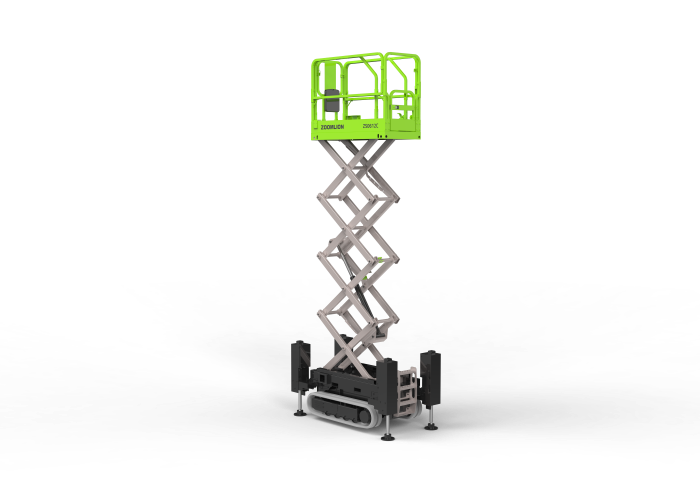
Solar farm construction requires coordinated work across large sites where ground conditions, equipment access, and installation schedules can vary significantly. From assembling mounting structures to connecting electrical components, crews often need reliable access to elevated work areas without disrupting surrounding activities. A crawler scissor lift can support these tasks by providing a mobile working platform suited to selected uneven-terrain applications. For solar EPC contractors and equipment rental companies, understanding its capabilities helps determine where it fits into an efficient installation plan.
Why Ground Conditions Matter on Solar Farm Projects
Solar farms are frequently developed on agricultural land, open fields, or previously undeveloped sites. Construction may involve compacted soil, gravel access roads, sloped sections, and areas affected by rain. These conditions can complicate equipment movement, especially when conventional access platforms are designed primarily for firm, level surfaces.
Site preparation remains essential, but it does not eliminate every access challenge. Contractors must assess ground bearing capacity, drainage, travel routes, and working-area stability before selecting machinery. A tracked scissor lift can offer an additional option for projects where its undercarriage and operating limits suit the site conditions.
Supporting Elevated Installation Tasks
Solar farm installation involves more than positioning panels. Crews may need to work on mounting frameworks, cable management systems, lighting, monitoring equipment, and electrical infrastructure. An elevated platform can bring personnel and compatible tools closer to these work areas, reducing repeated climbing and repositioning associated with ladders.
The suitability of a crawler scissor lift depends on the required working height, platform load, access width, and task duration. Compact dimensions can be particularly useful when equipment must move between rows or operate near installed structures. However, contractors should confirm clearance around panel arrays and account for underground services before establishing travel routes.
Improving Mobility Across Challenging Terrain
Tracked undercarriages can distribute machine weight across a larger contact area than some conventional wheel configurations, depending on the equipment design. Rubber crawlers may also help reduce ground pressure and improve traction on suitable surfaces. These characteristics can be valuable when moving between designated work zones on a solar project with variable ground conditions.
Nevertheless, tracks do not make a machine suitable for every soft or uneven surface. Wet soil, deep mud, loose fill, and poorly compacted ground may still present risks. Before deployment, site teams should check the manufacturer’s operating limits and verify that the route can support the machine’s total weight.
Selecting the Right Equipment for the Job
Equipment selection should begin with a task-based assessment rather than a general preference for tracked machinery. Contractors need to consider working height, platform capacity, machine dimensions, ground clearance, gradeability, slope limits, and transportation requirements. Battery capacity and charging arrangements also affect how equipment can be scheduled across a large installation site.
The ZS0612C from Zoomlion Access illustrates how these considerations can be evaluated against published specifications. This model offers a maximum working height of 7.8 m and a platform capacity of 230 kg. Its rated capacity on the deck extension is 113 kg, while the platform accommodates up to two workers under the specified operating conditions.
The machine measures 2.19 m in overall length and 1.15 m in width, with a minimum ground clearance of 0.08 m. Its listed gradeability is 30% (17°), and its maximum working slope is 12° laterally and 7° longitudinally. These figures are specification limits, not blanket permission to operate on any slope; the manufacturer’s instructions and actual site conditions remain decisive.
How Zoomlion Access Fits into Equipment Planning
For contractors comparing access equipment, a tracked scissor lift manufacturer should provide sufficiently detailed specifications to support risk assessments, fleet planning, and task allocation. Zoomlion Access lists the ZS0612C in its crawler scissor lift range and identifies the model as CE certified. Its published power specifications include four 12 V, 240 Ah batteries and a 24 V, 30 A charger.
These details help fleet managers assess charging arrangements, transportation needs, and compatibility with project workflows. The machine’s stowed drive speed is rated at 2 km/h, while its listed raised drive speed is 0 km/h. Consequently, work planning should account for repositioning between tasks rather than assume the platform can travel while elevated.
When evaluating a tracked scissor lift manufacturer, buyers should also review operator training requirements, maintenance support, parts availability, and local service arrangements. Product specifications establish technical capabilities, but dependable project performance also depends on inspection procedures, operator competence, and appropriate equipment selection.
Integrating Access Equipment into Site Safety Plans
A productive installation schedule begins with a clear understanding of hazards. Contractors should designate travel routes, establish exclusion zones, protect electrical infrastructure, and coordinate lifting operations with other trades. Ground conditions should be reassessed after heavy rain or significant changes to the work area.
Personnel must follow the applicable regulations, equipment manual, and site-specific risk assessment. Platforms should operate only within their permitted slope and load limits, with guardrails and other required protective systems in place. Workers must also receive appropriate training, and emergency lowering procedures should be understood before work begins.
A crawler scissor lift should never be treated as a substitute for ground preparation or fall prevention planning. Its value depends on matching its capabilities to the task while maintaining safe distances from trenches, panel structures, overhead hazards, and other equipment.
Building a More Effective Solar Installation Fleet
Solar EPC contractors benefit from combining equipment according to the different demands of each construction phase. Compact access platforms may serve elevated installation and electrical tasks, while other machines handle heavier lifting, material transport, or work at greater heights. This approach helps avoid using one equipment type for tasks outside its intended application.
Before procurement or rental, project teams should compare technical specifications with actual site measurements and expected workloads. A qualified tracked scissor lift manufacturer can provide product documentation that supports these decisions, but final selection should reflect verified ground conditions, operating restrictions, and project requirements.
Matching Equipment to Site Conditions and Project Goals
Tracked access platforms can contribute to solar farm installation by helping crews reach elevated work areas across suitable uneven terrain. The ZS0612C from Zoomlion Access provides a specific example, with a 7.8 m working height, 230 kg platform capacity, and published slope and mobility limits.
For procurement teams, the best choice is not necessarily the machine with the broadest capabilities. It is the equipment that matches the site’s terrain, working height, load requirements, and safety procedures. Careful planning and specification checks help contractors coordinate installation work while managing operational risks and project costs.
