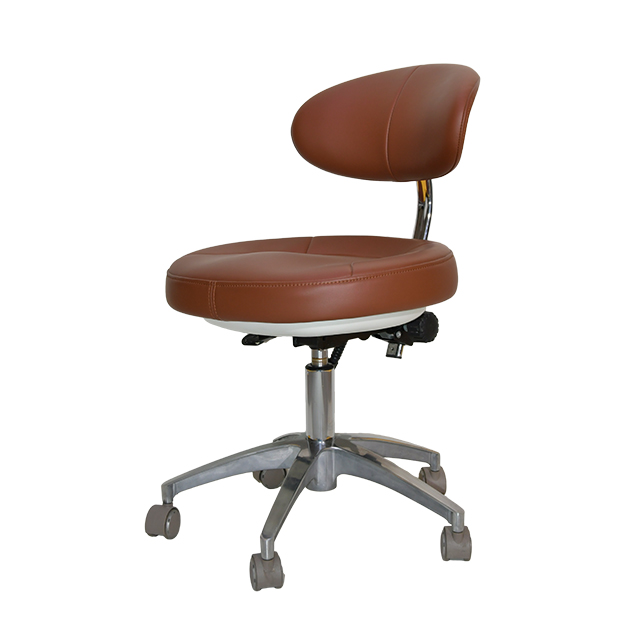
Choosing an operator stool is not simply a matter of finding the softest seat or the model with the most adjustment levers. Dentists move differently during treatment. Some prefer a straightforward seat that lets them reposition freely, while others need more control over seat angle, torso support, backrest position, or leg placement.
That makes a meaningful comparison more useful than a simple feature list. The current Roson range includes RS-03, RS-05, RS-06, and RS-07, with each model using a different combination of seat structure, adjustment, support, and mobility features. The better choice depends on what the operator actually needs to change during a procedure.
Four Stools, Four Different Ways to Support the Operator
The four models should not be viewed as four versions of exactly the same product. Their differences become clearer when the comparison starts with how much control the operator wants over the sitting position.
RS-03 takes a comparatively straightforward approach, combining pneumatic height adjustment, a T-shaped trunk support arm, an aluminum base, and quiet casters designed for smooth movement.
RS-05 moves toward a more structured sitting experience. Its U-shaped cushion, ergonomic tilt, adjustable foot ring, large backrest, and adjustable torso support give the operator more ways to establish a particular working position.
RS-06 is more adjustment-oriented. It provides eight-way control and adjustment, a 5-degree forward tilt, and 360-degree silent casters.
RS-07 takes another route, combining a U-shaped seat design with adjustable seat depth, an adjustable backrest, and a contoured leg-support area.
So the comparison is not simply “basic versus premium.” It is about which type of adjustment and support is most relevant to the operator.
RS-03 Keeps the Configuration Straightforward
RS-03 is a sensible reference point for buyers who do not need a highly configurable sitting system. Its pneumatic height mechanism provides the basic positional adjustment required to establish an appropriate working level, while the T-shaped trunk support adds another point of body support.
The base is also designed around practical movement. The model uses wear-resistant silent wheels, an aluminum base, and hard-floor casters intended to roll smoothly over surfaces such as tile and hardwood.
That combination makes RS-03 particularly relevant when the purchasing priority is a functional operator stool without an extensive collection of positioning controls.
It can also make sense in environments where stools need to be shared. A straightforward configuration gives different users fewer mechanisms to learn and makes the main adjustment task—setting the sitting height—relatively direct.
For buyers comparing a dental stool range, this model establishes an important baseline: more adjustment is not automatically better if the operator does not need it.
RS-05 Adds More Control Around the Seat and Lower Back
RS-05 changes the comparison because its design focuses more heavily on how the operator sits rather than simply where the stool is positioned.
The U-shaped cushion changes the available space around the thighs and central sitting area. The model also incorporates ergonomic tilt and a large anatomically shaped backrest, while the adjustable foot ring gives the operator another way to establish a supported sitting position.
Its torso support is another notable distinction. The support can be adjusted and converted for left- or right-hand operation, which is particularly relevant when the operator’s working direction changes.
This makes RS-05 a stronger candidate for buyers who place greater emphasis on body support during longer procedures rather than simply wanting a movable seat.
The comparison with RS-03 is therefore quite practical. RS-03 concentrates on core stool functions and straightforward support. RS-05 adds more structure around the hips, legs, back, and torso.
Neither approach is universally superior. The more useful question is whether those additional support features correspond to the operator’s actual working habits.
RS-06 Is Built for Operators Who Fine-Tune Their Position
RS-06 moves the comparison toward adjustability. Its eight-way control and adjustment system gives the operator considerably more opportunity to personalize the stool than a basic height-adjustable configuration.
The 5-degree forward tilt is particularly relevant to operators who prefer a more forward-oriented working position. Rather than keeping the seat in one fixed plane, the design provides another variable that can be adjusted around the dentist’s preferred posture.
Movement is also addressed through 360-degree silent casters. The manufacturer describes them as supporting smooth and quiet mobility within the operatory.
For a clinic comparing several models, RS-06 is therefore less about adding features for their own sake and more about giving the operator more ways to fine-tune the stool.
That can be valuable when different dentists have noticeably different sitting preferences. It can also matter in practices where the same operator changes position frequently according to treatment type.
The trade-off is straightforward: additional adjustment only creates value when someone actually uses it. A buyer who wants a simple, quick setup may prefer a less configurable model.
RS-07 Changes the Comparison With Seat Depth and Leg Support
RS-07 approaches the problem from a different direction again. Instead of relying primarily on multiple adjustment controls, it places particular attention on the relationship between seat depth, backrest angle, and lower-body positioning.
Its seat depth can be adjusted from 300 to 428 mm, while the backrest can move between 90° and 110°. The design also incorporates a 20° angled contoured leg-rest area and a U-shaped ventilation structure.
Seat depth is particularly useful in a comparison because operators do not all have the same body proportions. A fixed seat depth can place the backrest too far forward or too far back for a particular user. Adjustable depth provides another way to establish a closer fit.
The model also uses a wide aluminum base and silent nylon casters, giving it a combination of structured body support and mobile positioning.
RS-07 may therefore appeal most to buyers who want the stool to accommodate different sitting positions and body dimensions, rather than simply providing a conventional seat with height adjustment.
Which Model Is the Strongest Fit for the Way the Clinic Works?
A useful comparison should end with purchasing scenarios rather than declaring one model universally “best.”
RS-03 is the straightforward choice when the priority is essential height adjustment, basic trunk support, durable construction, and smooth movement.
RS-05 is more suitable when the operator wants a U-shaped seat, ergonomic tilt, foot support, back support, and adjustable torso positioning.
RS-06 makes more sense when individual adjustment is the deciding factor. Its eight-way control, 5-degree forward tilt, and silent 360-degree casters provide a more configurable working position.
RS-07 stands apart through adjustable seat depth, a 90°–110° backrest, U-shaped seating, and angled leg support. It is the model to examine when seat fit and lower-body positioning are major concerns.
For purchasing teams, the comparison should therefore be made in this order: How does the operator sit? How often does the position change? Which areas need support? How much adjustment will actually be used?
That approach is more reliable than choosing a stool simply because it has the longest feature list.
Tailored to diverse clinical settings and personal preferences, Roson’s dental operator stool range is available in four versatile configurations.
The best dental operator stool isn’t necessarily the one with the most complex features. While the RS-03 appeals to those who value simplicity, the RS-05, RS-06, and RS-07 excel when specialized support or enhanced adjustability is required. True selection isn’t about finding a universal favorite—it’s about matching the exact design to the operator’s physical positioning needs.
