Electronic equipment used in industrial control, renewable energy, communication, and automotive applications relies on carefully selected magnetic components to maintain stable electrical performance.
Among these components, inductors help regulate current, reduce ripple, and support energy conversion. Choosing an experienced inductor manufacturer is therefore an important step for equipment developers seeking consistent production quality and application compatibility.
Understanding the Engineering Role of an inductor manufacturer
An inductor manufacturer does far more than produce standard magnetic components. Engineering teams typically participate in magnetic design, material selection, winding structure optimization, and production validation according to the electrical requirements of different industries.
For B2B equipment manufacturers, this collaboration helps match inductance, current capability, resistance, and mechanical dimensions with the target application. Instead of relying on universal designs, customized magnetic solutions can improve compatibility with specific power architectures while simplifying system integration.
As electronic systems continue to increase in power density, inductors must also balance thermal performance, electromagnetic characteristics, and installation space. These design considerations become increasingly important in industrial power modules, communication equipment, and renewable energy systems.
Why Electrical Parameters Matter More Than Appearance
When selecting an inductor, external dimensions are parts of the evaluation process. Engineers usually begin by reviewing inductance, saturation current, rated current, DC resistance, and operating conditions before comparing physical size.
Inductance influences how effectively the component stores energy and smooths current. DC resistance affects conduction loss, while saturation current indicates the maximum current level before magnetic performance begins to change significantly. These values work together rather than independently.
Mechanical dimensions also affect PCB layout and enclosure planning. Maintaining dimensional consistency helps simplify automated assembly and supports repeatable manufacturing across large production batches.
Product Example for Industrial Power Applications
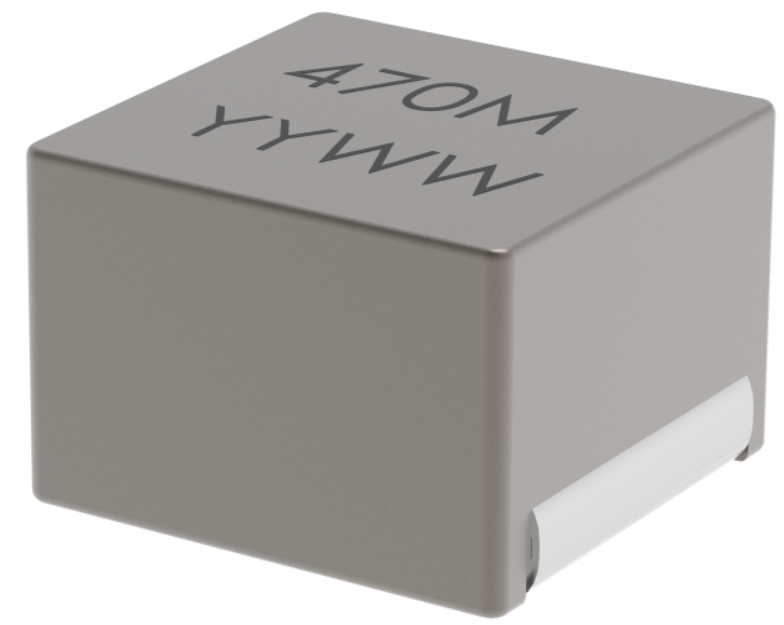
As one example of molded power inductors, the MHA2213SG SERIES includes Item Number: MHA2213SG221M. The component measures 22.5±0.3 mm in length, 22.0±0.3 mm in width, and 12.7±0.3 mm in height, providing a compact structure suitable for many power circuit layouts.
Its specified inductance is 220±20% μH with a maximum DCR of 103 mΩ. The rated saturation current reaches 9 A, while the Irms value is 7 A. These published specifications provide engineers with measurable reference points during circuit selection and verification.
Rather than evaluating one specification alone, designers generally consider all electrical parameters together so the selected component matches the intended converter topology, thermal environment, and operating load.
Magnetic Components Across Multiple Industries
Power electronics continue to expand into increasingly specialized applications. Different industries often require magnetic components designed around unique electrical environments instead of using identical products.
Power module designs commonly employ high-frequency electronic transformers, PFC inductors, common-mode inductors, differential-mode inductors, planar transformers, and molded power inductors to support efficient energy conversion and filtering functions.
New energy vehicles introduce another layer of engineering requirements. Automotive-grade magnetic components such as OBC transformers, DC-DC transformers, drive transformers, BMS transformers, and filter inductors are developed according to the operating needs of vehicle electrical systems.
Communication infrastructure also depends heavily on magnetic technology. Traditional network transformers remain widely used, while chip LAN transformers provide additional options for newer communication equipment with compatible electrical performance.
Manufacturing Consistency and Process Control
A reliable magnetic component is not determined only by design calculations. Stable production processes help ensure that electrical characteristics remain consistent from one manufacturing batch to another.
Core material inspection, winding precision, solder quality, encapsulation, dimensional verification, and electrical testing all contribute to repeatable manufacturing. These production stages help reduce variation that could otherwise affect system performance during long-term operation.
For industrial customers purchasing large production volumes, manufacturing consistency supports predictable assembly efficiency and simplifies quality management throughout the supply chain.
Custom Development for Different System Requirements
Standard catalog products satisfy many applications, but specialized industries often require customized magnetic designs. Equipment manufacturers may request adjustments to inductance values, winding structures, current ratings, package dimensions, or installation methods based on project requirements.
An experienced inductor manufacturer can participate during early product development, allowing magnetic components to be optimized alongside the complete electrical system rather than being selected only after circuit completion.
This collaborative approach is commonly used in power modules, automotive electronics, energy storage equipment, communication systems, and other industrial applications where electrical characteristics vary between projects.
How Mentech Contributes to Magnetic Component Development
Mentech focuses on the customized development and manufacturing of magnetic components serving multiple industrial sectors. Their product portfolio includes high-frequency electronic transformers, PFC inductors, common-mode and differential-mode inductors, planar transformers, and molded power inductors for power module applications.
They also develop automotive-grade magnetic components including OBC transformers, DC-DC transformers, drive transformers, BMS transformers, and filter inductors for new energy vehicles. In solar-storage-charging systems, their products include common-mode and differential-mode inductors, micro-inverter transformers, and high-power DC-DC transformers.
For communication equipment, they provide both traditional network transformers and chip LAN transformers that are compatible with conventional network transformer applications, allowing equipment manufacturers to select products according to different design requirements.
Conclusion
Selecting an inductor manufacturer involves more than comparing catalog specifications. Engineering capability, manufacturing consistency, customization support, and product diversity all influence long-term project success.
As electronic systems continue to evolve across industrial, automotive, communication, and renewable energy applications, magnetic components remain an essential part of efficient power conversion. Companies such as Mentech provide customized magnetic products covering multiple application fields, giving B2B equipment manufacturers additional options when developing reliable electronic systems.
